
.svg)
.svg)


Not in the last cycle, new data shows
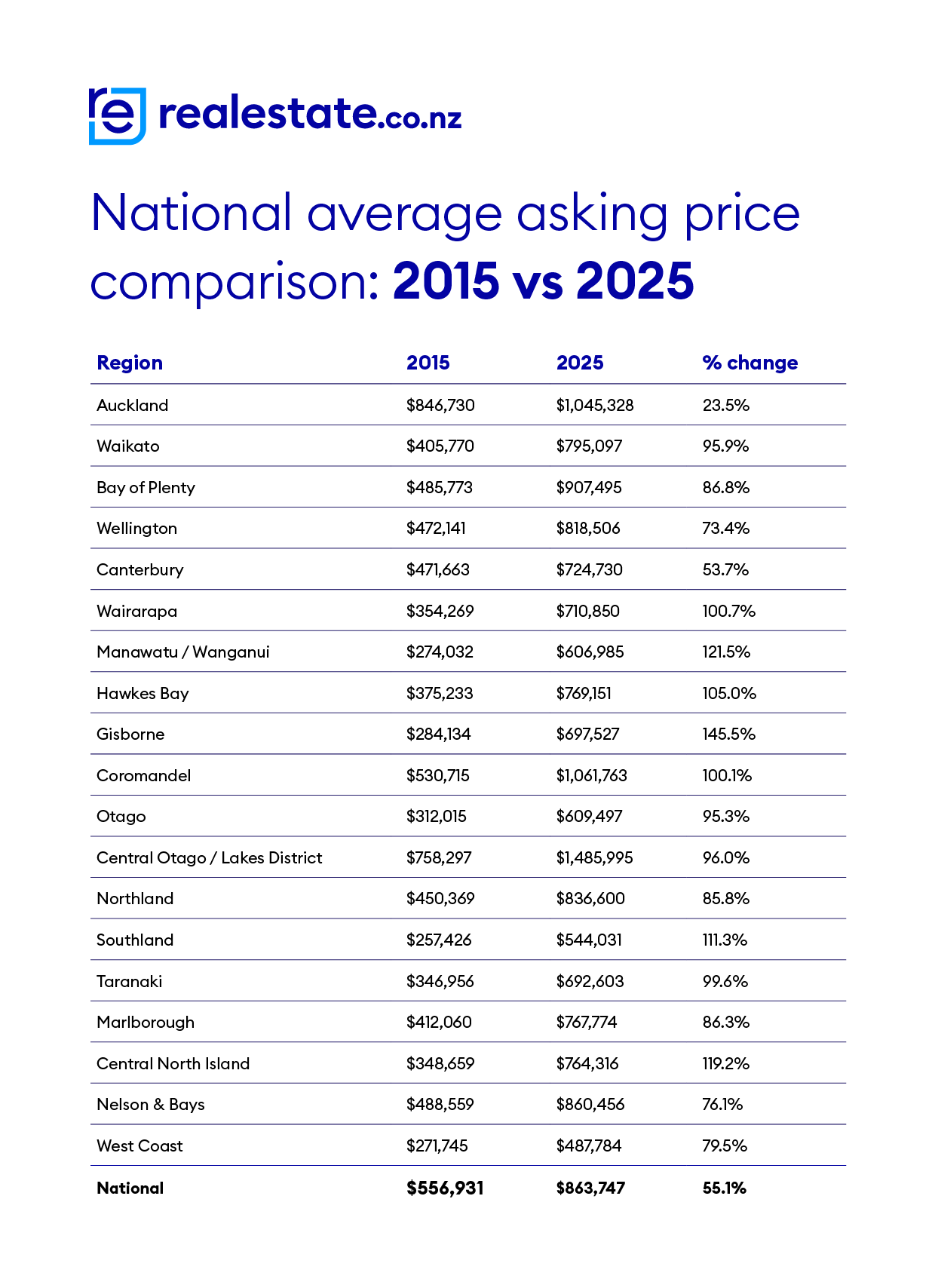
- National average asking price increased by 55.1% in past 10 years
- Auckland’s average asking price increases only 23.5%
- The regions take the cake for delivering the biggest returns with seven doubling in price since 2015
- Gisborne reports 145% increase from $284,134 in 2015 to $697,527 in 2025
Lore tells us that property prices double every 10 years, but the latest data from realestate.co.nz shows this wasn’t the case nationally in the last decade. Between 2015 and 2025 New Zealand's national average asking price only increased by 55.1%, from $556,931 to $863,747.
While the highly sought-after doubling in value milestone may not have occurred nationally, seven of New Zealand’s 19 regions did achieve the coveted accolade.
Gisborne topped the chart with a 145.5% increase in its asking price from $284,134 in 2015 to $697,527 in 2025. Manawatu/Whanganui followed with a 121.5% increase from $274,032 in 2015 to $606,985 in 2025 and Central North Island recorded the third highest increase of 119.2% from $348,659 in 2015 to $764,316 in 2025.
Of the major centres, Auckland delivered the least value increase in the last decade with a 23.5% increase from $846,730 in 2015 to $1,045,328 in 2025. Waikato was the standout performer with a 95.9% increase in average asking price over the decade, from $405,770 in 2015 to $795,097 in 2025.

Vanessa Williams, spokesperson for realestate.co.nz, says while it may be true for some, the last decade has debunked the notion as a general rule. “The idea that property always doubles in value every 10 years is a simplification that doesn’t reflect how the market really works,” says Williams. “Property moves in cycles – we have peaks, plateaus, and periods of correction, so doubling in value isn’t a guarantee and it will always depend on individual properties and locations as well.”
“Over the past decade, we’ve seen significant regional variation and, in many areas, growth has fallen well short of that aspirational ‘doubling in value’ benchmark. While prices generally rise over time, growth is rarely linear and depends heavily on when in the cycle you buy and sell.”
Which regions fetched returns for homeowners?
Southland (111.3%), Hawke’s Bay (105.0%), Wairarapa (100.7%) and Coromandel (100.1%) were the four remaining regions that more than doubled their average asking price during the past decade.
Williams says despite an ever-changing landscape, the value of property continues to increase over the long term.
“Over the past 10 years, we’ve seen the New Zealand property market navigate some of the most dramatic economic shifts in recent history, from a pandemic-fuelled boom to a sharp market reset. In the same period, we’ve seen significant regulatory change, with the introduction of loan-to-value (LVR) restrictions, the bright-line test, and more recently, debt-to-income (DTI) ratios.
Through it all, property has remained a national conversation and a first-choice of investment for many Kiwis.”
For media enquiries, please contact:
Hannah Franklin | hannah@realestate.co.nz
Want more property insights?
- Market Insights: Search by suburb to see median sale prices, popular property types and trends over time.
- Sold properties: Switch your search to sold to see the latest sale prices and an estimated value in the current market.
Find a glossary of terms here.
Share
-
.svg)
.svg)
.svg)